
Blog
The art of imperfection: the beauty of handmade

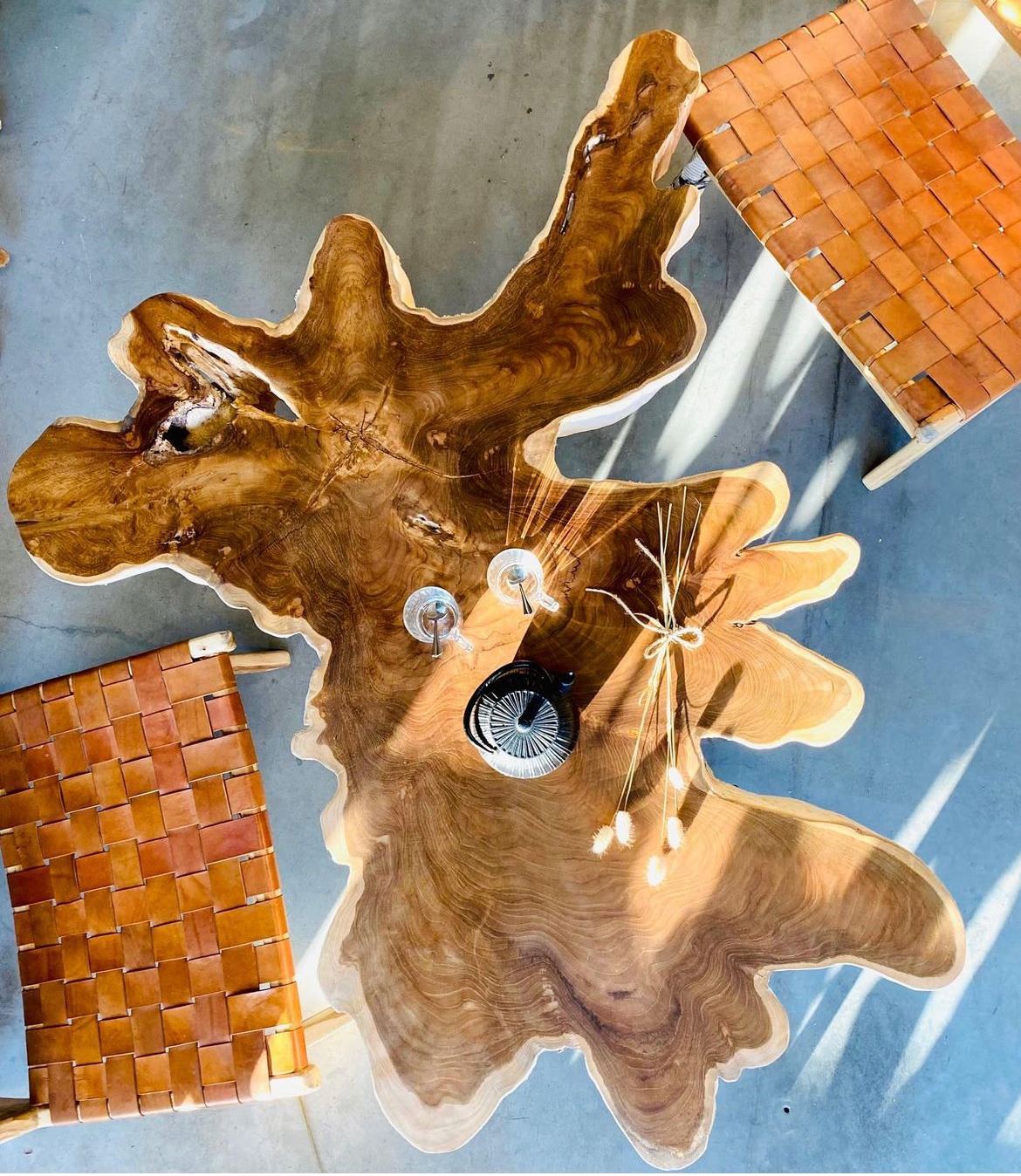
There is a beauty that cannot be measured by symmetry, precision, or regularity. An imperfect, vibrant beauty, imbued with humanity. It is the beauty of the handmade—the kind that doesn’t seek to erase irregularities but to honor them.
In a world shaped by standardized perfection, craftsmanship offers a breath of fresh air. It reminds us that the human hand still has something to say, something the machine ignores: the rhythm of the gesture, the patience, the resistance of the material, the emotion of the unpredictable result.
The art of imperfection is not about accepting flaws, but about recognizing their value. It celebrates the uniqueness of a work, the trace of life, the story of craftsmanship. Each irregularity tells a story: the pressure of a tool, the heat of a flame, the grain of wood. These details, far from being detrimental, create a presence—that of an object that is inhabited, sensitive, and authentic.
This philosophy has always existed in the world’s artisanal cultures. Japan calls it wabi-sabi : the beauty of simplicity, of the natural, of the transient. In this vision, nothing is fixed, nothing is eternal, and it is precisely this fragility that creates depth.
Handmade work follows this same logic: it favors raw materials over smooth surfaces, controlled gestures over automated processes, and slowness over mass production.
Each artisan works in harmony with nature. They don’t impose their will; they adapt to the shape of the wood, the density of the stone, the hue of the clay. This dialogue between hand and material is at the heart of authentic design.
A handmade piece of furniture bears the marks of time. A slight irregularity in the structure, a variation in color, a roughness in the grain—all these imprints give it its personality. These traces are not flaws, but memories. They remind us that the object was crafted, not mass-produced.
And this difference changes everything. Because behind every handcrafted object, there is a creator. A human being, with their own sensibility, experience, and way of interpreting the material.
Industrial design aims for uniformity. Handcrafted design aims for truth.
One multiplies, the other individualizes. One copies, the other expresses.
In the world of contemporary design, more and more creators are returning to this sensory approach. They reject overly perfect surfaces, glossy finishes, and impersonal lines. They prefer the patina of leather, the roughness of concrete, and the unpredictable grain of wood.
Handmade then becomes an act of resistance, a way of placing humanity back at the heart of the creative process.
Imperfection, in this context, becomes an aesthetic language. It creates a connection between the maker and the user. It tells the story of the hand, of time, of the material.
A handcrafted object, even a silent one, speaks. It evokes the passion of the gesture, the precision of the eye, the warmth of the workshop. It also evokes respect for rhythm: a bowl turned slowly, a fabric woven by hand, a piece of wood sculpted over hours.
These objects carry within them a different energy—a subtle vibration that transforms the way we perceive them.
Appreciating handmade items means learning to see things differently. It means no longer seeking perfection but emotion. It means understanding that a living object is not fixed in its beauty: it evolves, it develops a patina, it changes color, it improves with age.
It is this natural transformation that makes it precious.
Design, in its truest form, is not meant to conceal the material but to reveal it. And nothing reveals it better than the work of the hand.
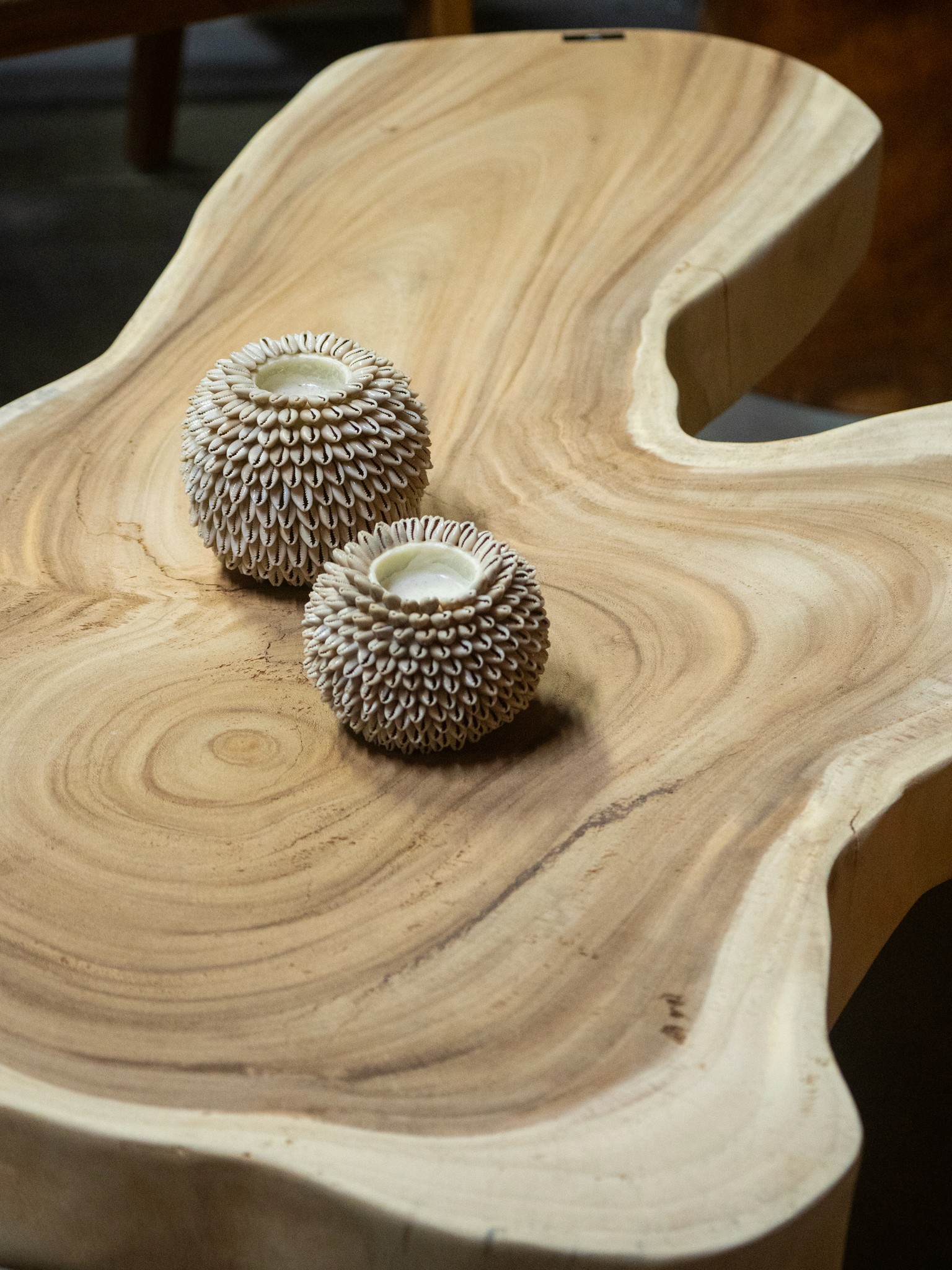
Craftsmanship reconciles time and matter. In a workshop, nothing is instantaneous. Every step counts, every gesture is part of a continuum.
The craftsman knows how to listen. He knows that absolute perfection does not exist, and that it is precisely this imperfection that gives the object its beauty, its warmth, its truth.
In a world where we produce faster than we observe, this approach is almost revolutionary. It places creation back on a human level: that of rhythm, of error, of learning.
A handmade object carries the breath of its creator. It conveys an emotion, a thought, sometimes even a silence. You can feel the hand, the pressure, the tension, the release.
It’s an intimate dialogue between the creator and the material. And when the object reaches its owner, this dialogue continues. The table absorbs the memories of shared meals, the chair bears the marks of time, the vase embraces entire seasons.
Imperfection becomes memory. It inscribes the object in time, in life.
This philosophy goes beyond mere production. It touches on our relationship with consumption. Choosing a handcrafted piece is an act of conscience. It’s about preferring depth to quantity, sincerity to appearances.
Handmade items teach patience and gratitude. They invite us to look at materials differently, to understand where the wood comes from, who wove the linen, how many hours the ceramic took to create.
Each object becomes a fragment of the world, a trace of humanity.
In contemporary design, this approach translates into a desire to reconnect places and people through materials. The return of raw wood, washed linen, natural marble, and full-grain leather: all signs of a need for authenticity, for the tangible, for durability.
These materials, imperfect by nature, resonate differently. They speak of the earth, the hand, the light.
They stand in contrast to the coldness of plastic and the standardization of polished metal. Their charm lies in their living character: they breathe, they transform, they age.
In this approach, design doesn’t simply adorn the space. It tells a story. It weaves connections between past and present, between hand and thought.
Each handcrafted piece becomes a witness to our time, a silent manifesto in favor of slowness and quality.
And this is perhaps the greatest beauty of the handmade: it transcends time without ever seeking to dominate it.
This quest for perfect imperfection—the kind that doesn’t shock but moves us—demands a rare sensitivity. It requires accepting chance, welcoming surprise, embracing the unexpected.
The designer or craftsperson then becomes a mediator between nature and humanity. They shape, guide, but don’t control everything. They let the material speak.
And in this dialogue, something profoundly true is born.
Contemporary design, when nourished by this approach, rediscovers its original meaning: connecting beauty and utility, action and thought, object and life.
It is an aesthetic of the essential, a way of saying that beauty doesn’t need to be perfect to be powerful.
In the handmade, we rediscover what modernity has sometimes forgotten: the poetry of reality, the nobility of simplicity, the depth of time.
Imperfection, far from being a flaw, becomes a value. It embodies freedom, sincerity, and a connection with nature.
In a world where everything seems reproducible, the imperfect object becomes unique. And in this uniqueness, it rediscovers its strength, its soul, its truth.
Ultimately, that’s the beauty of handmade things: a sincere, patient, and imperfect beauty. A beauty that doesn’t need to justify itself, because it simply lives.