
Blog
Creating a calming interior: between nature and minimalism

Creating a calming interior isn’t about emptying the space, but about giving it room to breathe. In a world saturated with images, noise, and objects, minimalism emerges as a form of gentleness: a way to slow down, filter, and return to the essential.
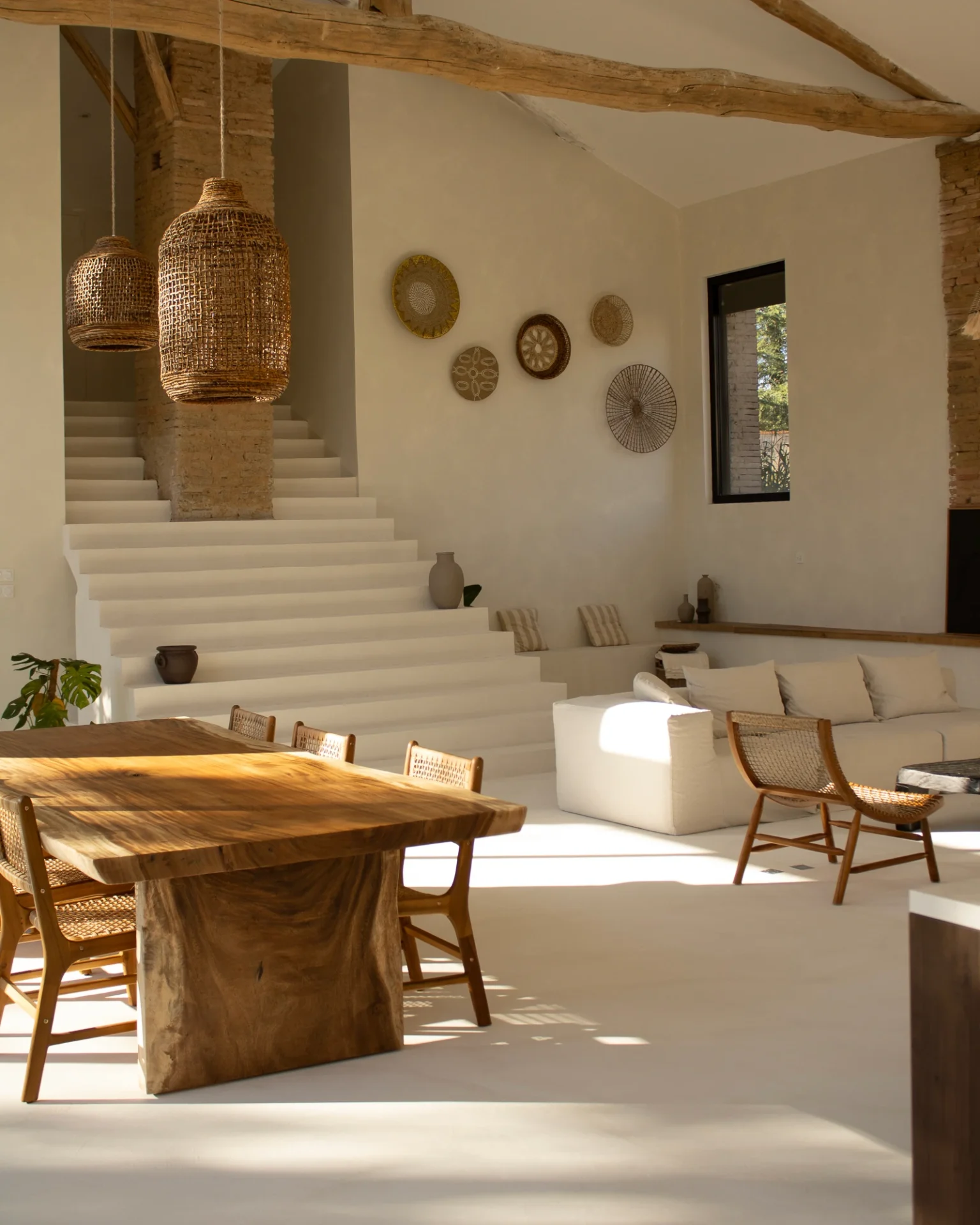
But this minimalism isn’t meant to be cold or rigid. Combined with nature, it becomes vibrant, organic, and luminous. It doesn’t seek to erase, but to reveal: the texture of raw wood, the light that flows through a room, the subtle hue of a fabric in the sunlight.
A calming interior is a subtle balance between function and emotion. Each element, chosen with intention, interacts with the others without imposing itself. A table becomes an anchor, an armchair a refuge, a plant a breath of fresh air.
In this type of space, nothing is there to fill a void. Everything is there to exist.
Calm does not arise from emptiness, but from coherence. From the absence of visual tension, from the harmony between light, color, and texture.
Calm often begins with light. Natural light must flow freely, without obstruction. It reveals volumes, softens contours, and warms surfaces. It brings materials to life.
A slightly translucent linen curtain is sometimes enough to transform the atmosphere of a room. Light then becomes a material in its own right—shifting, alive, unpredictable.
Nature, for its part, introduces a form of truth. It restores the balance that modernity has often forgotten. Wood, stone, linen, terracotta… these raw materials breathe, wear, and transform over time. They create a sensory and almost emotional connection with the space.
A wooden worktop bears the marks of daily life. A stone slab retains the memory of light. A natural textile softens with each wash. These changes, far from being flaws, are the sign of a home that is lived in.
Natural minimalism is based on a simple idea: removing the superfluous to reveal essential beauty. It’s not about stripping away, but about adjusting. About finding the right balance between function and emotion.
A calming interior imposes nothing. It offers a rhythm, a breath, a continuity.
The eye should be able to rest without interruption, the body should be able to move freely, the mind should be able to relax without distraction.
The choice of colors contributes to this harmony. Neutral tones, warm whites, beiges, soft grays, or mineral greens invite calm. They reflect light without overwhelming it. They form a silent backdrop against which each material can express itself.
Contrast, however, is not forbidden, but measured. A deep black, dark wood, or raw stone can enhance the presence of the space, provided its balance is respected.
Creating a calming interior also means accepting the slowness of the process. You don’t compose an atmosphere like you fill a room. Every object, every choice must have a reason for being. A calming interior isn’t a Pinterest image: it’s a living space, designed to last, evolve, and breathe.
The chosen objects often have a story. A vase brought back from a trip, a vintage lamp, a handcrafted piece. Minimalism doesn’t reject memory; it integrates it with discernment. Nature does the rest: a ray of sunlight on the ground, a shifting shadow on a wall, a plant slowly growing near a window.
Soothing design is therefore built around one intention: to create continuity between man and nature, between the visible and the sensory.
In this vision, the home is not a decoration. It is a living organism, an extension of oneself.
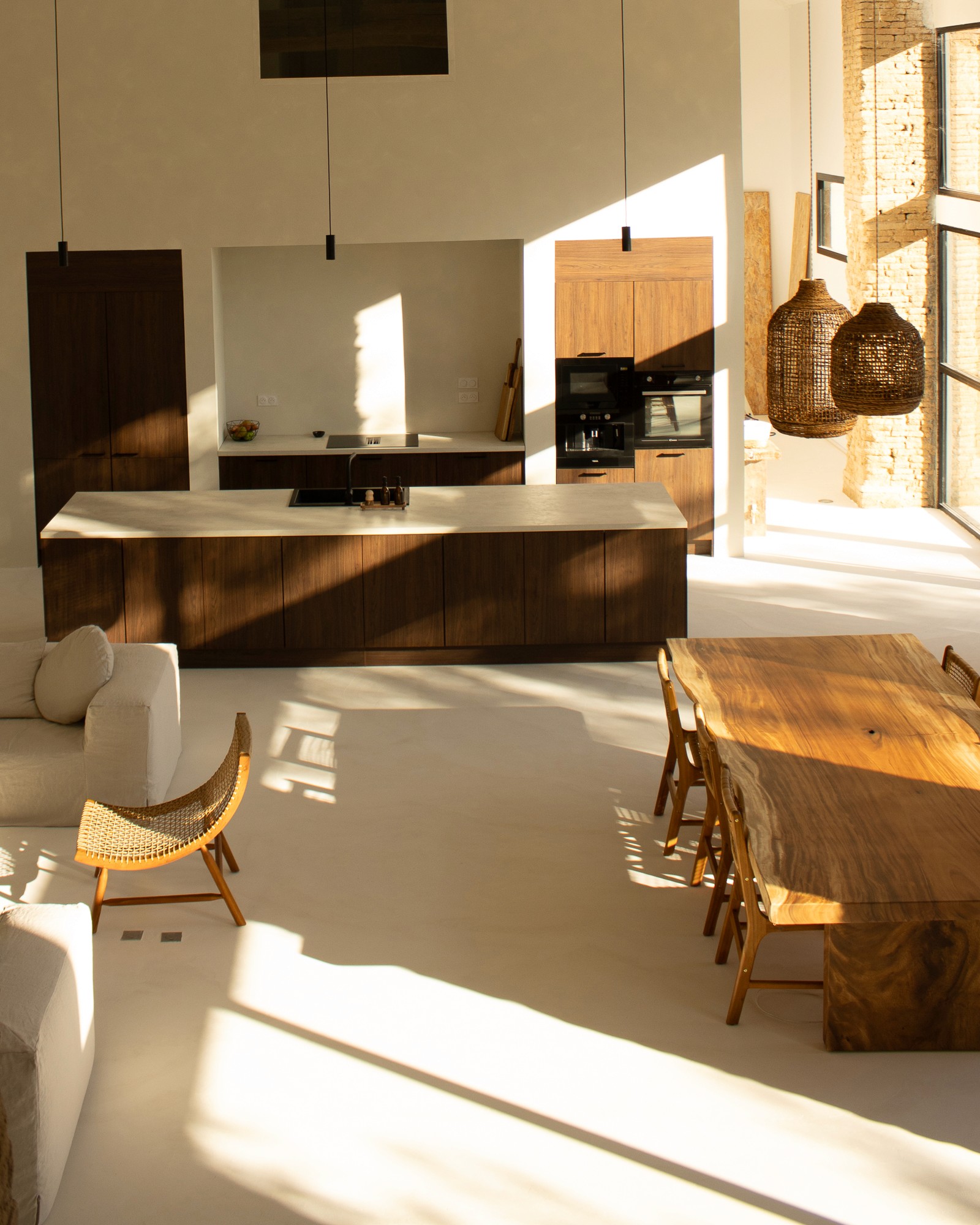
The harmony of a space depends not only on what we see, but also on what we feel. Sounds, textures, temperature, air circulation: everything contributes to this feeling of calm.
A soothing interior is a place where the senses are in balance. Where the hand touches the grain of the wood, where the foot feels the coolness of the floor, where the morning light becomes a familiar habit.
To create this harmony, coherence is essential. It’s not about applying a style, but about adopting a mindset.
We choose fewer objects, but of better quality. We prioritize quality over quantity, natural materials over synthetics, and durability over trends.
Design here isn’t decorative: it’s functional, calming, and thoughtful. It seeks to make life smoother, simpler, and more authentic.
Nature, ever-present, acts as a source of stability. Even in the city, it makes its presence felt in small touches: a houseplant, a dried bouquet, a piece of solid oak furniture, earthy-toned ceramics. These elements remind us that comfort comes not from accumulation, but from harmony.
Each living material introduces a sensory dimension: wood warms, stone soothes, textiles soften, light connects.
Minimalism, often perceived as austere, becomes warm and inviting when nourished by nature.
A clean, uncluttered space doesn’t mean an empty space. It means a controlled space, where every element has meaning. An object placed on a table has more value when it stands alone. A well-designed chair becomes a sculpture when it’s not surrounded by ten others.
The space breathes. And this breath, imperceptible yet ever-present, is the key to serenity.
Visual balance relies on lines. Straight lines create stability, curves introduce softness.
The interplay between these forms, between rigor and flexibility, structures the space while maintaining a sense of fluidity.
Volumes must be just right: neither too cluttered nor too empty. Too much rigidity freezes, too much freedom scatters. Calm lies in the middle ground.
But a calming interior isn’t just about the decor. It’s based on an attitude: that of fully inhabiting your space.
Taking the time to open the windows, light a candle, listen to the silence. Living in a peaceful place also means learning to respect it, to let it breathe, to find refuge in it.
The emotional dimension is essential. Visual comfort creates inner comfort. Visual order creates mental clarity.
When everything is in its place, the mind is calm. The home becomes an extension of the body, a place of balance between movement and rest.
A calming interior also reflects our relationship with time. It doesn’t strive to appear eternally new. It embraces aging, signs of wear, and changes in light. This acceptance of time makes the space feel alive, lived in, and authentic.
A slightly worn floor, a table marked by daily life, a fabric that softens: these details create a warmth that perfection cannot provide.
Nature and minimalism share this same logic: they value what is true, necessary, and essential.
They remind us that beauty lies not in accumulation, but in mastery. That a calm space is not empty, but filled with meaning.
They invite us to rediscover a form of inner balance through our environment.
Creating a calming interior is therefore an art of attentiveness.
It’s about listening to the light, feeling the textures, understanding volumes. It’s also about embracing silence, emptiness, and slowness.
Minimalism and nature are not opposed: they complement each other, they respond to each other. Together, they give birth to living, balanced, and profoundly human spaces.
And in the end, perhaps that is true luxury: a place that breathes, a place that soothes, a place that resembles us.